Discover what Most Searched Profiles means on MediaHubHQ, how search interest differs from profile views and trending activity, and why being actively searched can be a meaningful sign of audience interest and discovery.
People discover profiles on MediaHubHQ in different ways.
Someone might find a creator while browsing. Another person might follow a shared MediaHubHQ link. Others may already know the name of an artist, business, organization, professional, or creator they want to find.
That last type of discovery is especially interesting because it can represent active search interest.
MediaHubHQ's Most Searched Profiles chart helps highlight profiles receiving notable qualifying search interest during a selected period.
But what exactly does that mean? And how is being searched different from being viewed or trending?
Here's how it works.
What Is Most Searched Profiles?
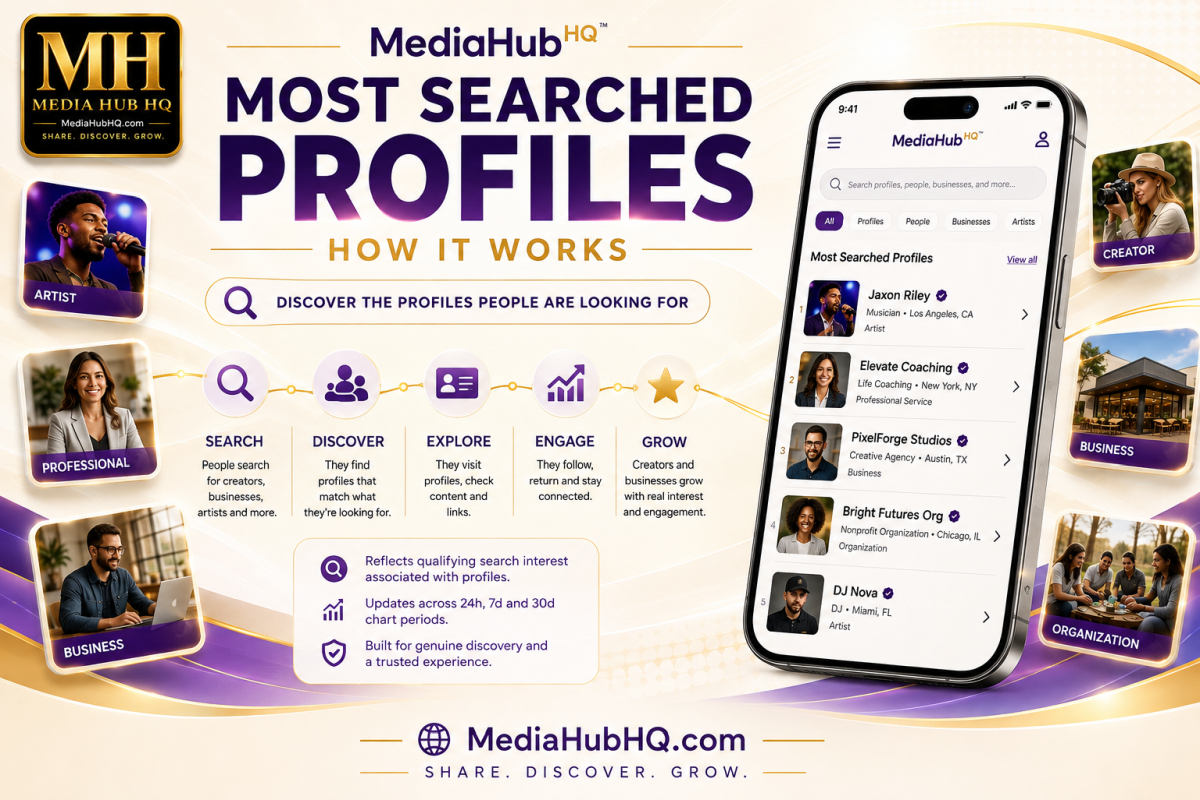
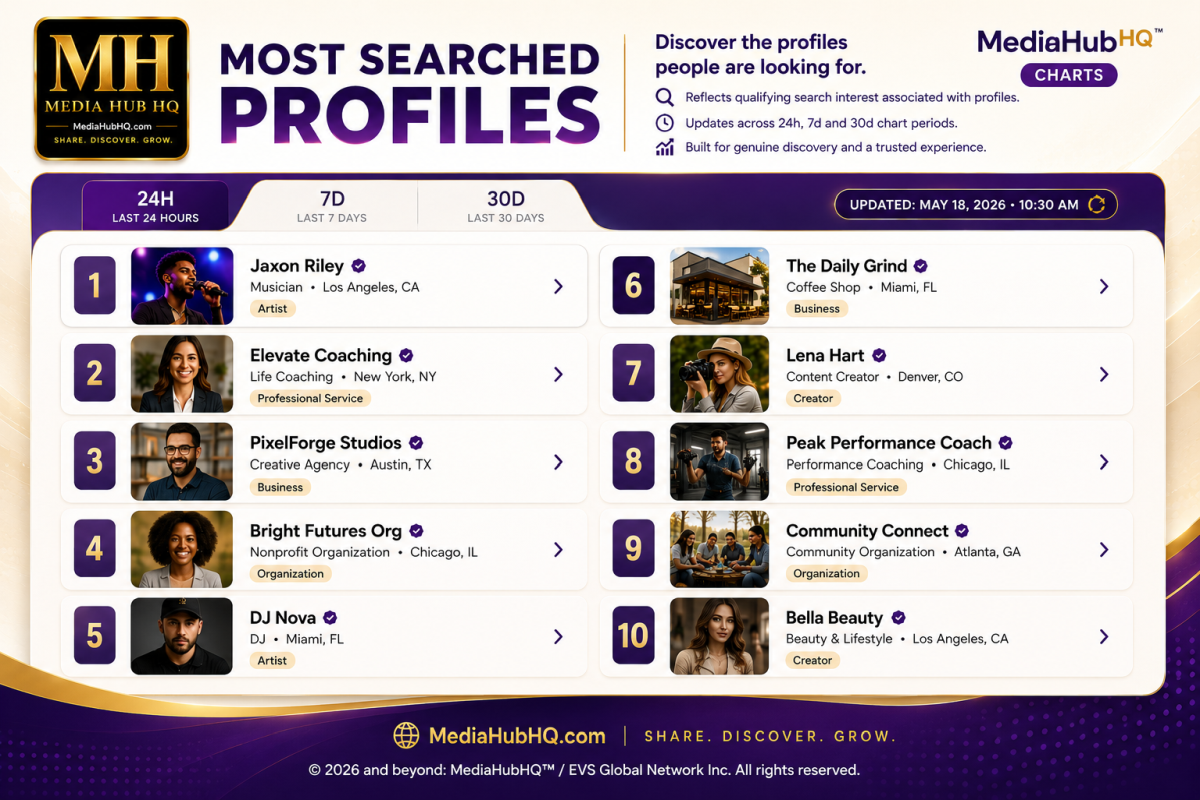
Most Searched Profiles is a MediaHubHQ Charts feature designed to highlight profiles receiving qualifying search interest on the platform.
Rather than displaying the words or phrases people type into Search, the chart focuses on eligible MediaHubHQ profiles associated with qualifying profile-search activity.
This distinction is important.
The purpose isn't to create a public list of everything people search for. It's to help viewers discover the profiles audiences are actively looking for on MediaHubHQ.
What Does Being “Most Searched” Mean?
Being Most Searched means a profile has received enough qualifying search interest to place it among the leading eligible profiles for the selected chart period.
In simple terms, people aren't only encountering that profile. They're looking for it.
That can make search interest an especially useful discovery signal.
A profile appearing in Most Searched might belong to an artist whose new release is attracting attention, a business people recently heard about, a creator being discussed elsewhere, an organization running a campaign, or a professional whose services people want to explore.
The reason behind the interest can vary considerably.
The chart reflects the search activity—not the reason for it.
A profile view and a profile search aren't necessarily the same thing.
Imagine someone sees a MediaHubHQ profile shared on social media and opens it. That's discovery through a link.
Now imagine someone visits MediaHubHQ, searches for a profile they're looking for, finds it through Search, and explores it. That's a different discovery journey.
Both interactions can be valuable, but Most Searched Profiles specifically focuses on qualifying search interest associated with profiles.
This helps give viewers another perspective on what's attracting attention across MediaHubHQ.
What About General Searches?
Not every search necessarily represents interest in one specific profile.
Someone could search for a broad topic, profession, category or interest because they want to discover what's available.
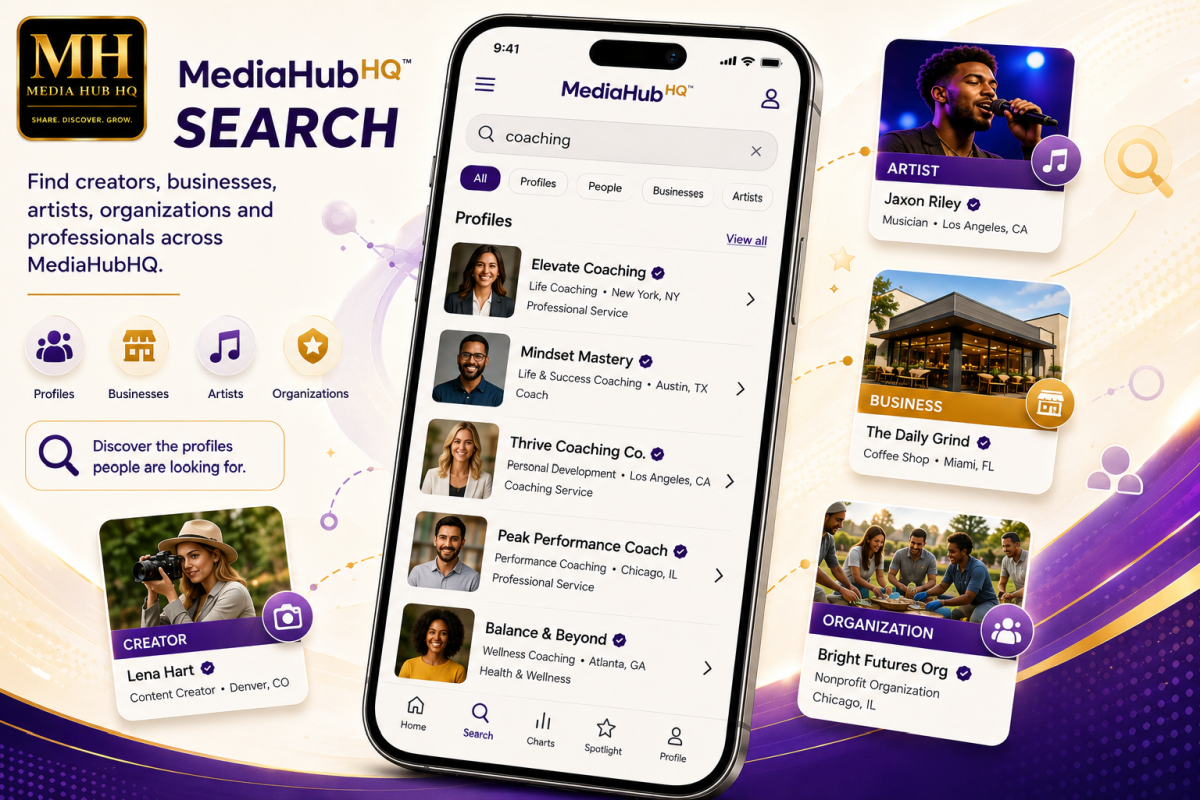
For example, a person might search for coaching.
They could then discover several relevant profiles and choose one to explore.
That search helped with discovery, but it shouldn't automatically be interpreted as direct search interest in every profile that appeared in the results.
Most Searched Profiles is intended to represent qualifying search activity that MediaHubHQ can appropriately associate with an eligible profile.
This keeps the chart focused on profile search interest rather than simply displaying general search activity.
Why Doesn't MediaHubHQ Display Popular Search Terms?
Search can contain all kinds of user-entered words and phrases.
Instead of turning raw search queries into a public leaderboard, MediaHubHQ's approach focuses the Most Searched chart on profiles.
That creates a more useful discovery experience while avoiding the assumption that every search phrase should become public-facing content.
Viewers can therefore see which eligible profiles are attracting search interest without MediaHubHQ needing to publish a running list of what individual users type into Search. The chart is about discovering profiles—not exposing people's searches.
How Are Most Searched Profiles Ranked?
MediaHubHQ evaluates qualifying profile-search activity within the selected chart period and uses that activity to determine the relative position of eligible profiles.
Profiles with stronger qualifying search interest during that period can appear higher in the chart.
The important word is current.
Most Searched isn't intended to be a permanent status.
It reflects search interest within a particular period of time.
As audience behavior changes, the rankings can change too.
Like other MediaHubHQ Charts features, search interest can be viewed across different periods:
A view can begin with something placed in front of you. A search often begins because you decided to look.
24h — approximately the previous 24 hours 7d — approximately the previous 7 days 30d — approximately the previous 30 days
These windows help tell different stories.
A profile experiencing a sudden burst of attention could perform strongly over 24 hours.
Another profile may receive steady search interest throughout the week.
And another could build sustained interest over a longer period and perform particularly well on the 30-day chart.
Changing the chart period can therefore change both which profiles appear and where they rank.
Why Can Rankings Change?
Search interest is dynamic.
People discover new creators. Businesses launch products. Artists release music. Organizations make announcements. Professionals receive publicity. Creators publish new work. A profile might suddenly receive attention from somewhere outside MediaHubHQ.
As those interests change, search activity can change with them.
Older qualifying activity can also move outside the selected chart period while newer activity enters it.
That's why Most Searched should be viewed as a current snapshot of search interest, rather than a permanent award.
Does Most Searched Mean Most Popular?
Not necessarily.
This is one of the most important distinctions to understand. Most Searched measures search interest.
It does not automatically mean most followed, most viewed, most clicked, most popular overall, highest quality, or endorsed by MediaHubHQ.
A profile can be heavily searched because people are curious about it, because its owner is promoting it effectively, because something new happened, or for many other reasons.
Search interest tells us that people are looking. It doesn't tell us everything about why.
How Is Most Searched Different From Trending Profiles?
The two charts answer different questions. Most Searched Profiles asks: Which profiles are audiences actively looking for? Trending Profiles asks: Which profiles are gaining broader activity and momentum?
Trending can reflect a wider picture of qualifying engagement around a profile, while Most Searched isolates the search-interest side of discovery.
That means a profile can perform strongly in Most Searched without holding the same position in Trending—and vice versa.
Those results don't conflict. They're measuring different dimensions of audience activity.
Can Search Discovery Still Help a Profile in Other Ways?
Yes.
Even when someone begins with a broad discovery search, what happens afterward can matter.
A person may search for a service, topic or type of creator, discover a profile they didn't previously know, open it, explore its links, read an Archive article, watch featured media, or return later.
That's where Search becomes more than a box at the top of a page.
It becomes part of the MediaHubHQ discovery journey.
A broad search may introduce someone to you.
Your profile then has to give them a reason to stay.
How Can Profile Owners Improve Their Discoverability?
There isn't a legitimate shortcut to becoming highly searched.
The better strategy is to make your MediaHubHQ presence clear, recognizable and worth finding.
Use the name your audience is most likely to recognize.
Choose a clear profile image or brand logo.
Write an informative profile description.
Keep your information current.
Add useful links to your work, services, releases or projects.
Publish relevant Archive content where appropriate.
Share your MediaHubHQ profile through the channels where your audience already follows you.
And when something important happens—a new release, project, appearance, article, service or announcement—give people a reason to look you up.
The goal isn't to manufacture searches.
The goal is to build real interest.
What If Someone Tries to Manipulate Search Rankings?
MediaHubHQ Charts is intended to reflect genuine platform activity.
Attempts to artificially manufacture search activity or otherwise misrepresent audience interest go against the purpose of the feature.
As MediaHubHQ grows, its Charts systems and safeguards may continue to evolve to support useful, trustworthy discovery.
For that reason, chart methodology and eligibility requirements may also change over time.
The Bigger Picture
Search is one of the clearest expressions of curiosity on a discovery platform.
A view can begin with something placed in front of you.
A search often begins because you decided to look.
That's what makes Most Searched Profiles interesting.
It gives MediaHubHQ another way to surface creators, businesses, artists, professionals and organizations attracting audience interest—without reducing discovery to follower counts alone.
Your profile doesn't have to be the biggest to become discoverable.
It needs to give people a reason to remember it.
A reason to look for it.
And, once they find it, a reason to explore.